
Zendesk continues its relentless pace of innovation, dropping new features and enhancements on what feels like a daily basis. Keeping up can be a full-time job, but we’re here to give you our expert opinion on what matters most. Here’s our take on the latest announcement from late June 2026.
Zendesk Suggested Assignees: The End of Ticket Ping-Pong?
What We Think:
Zendesk’s new Suggested Assignees feature, now in an open Early Access Program (EAP) for Copilot customers, is a promising step towards smarter ticket routing. By using AI to recommend the best agent for an escalation, it aims to cut down on the frustrating back-and-forth that kills resolution times. Our take is that this could be a game-changer for larger teams drowning in complex tickets, provided they have a clean and substantial ticket history for the AI to learn from. However, its real-world effectiveness hinges entirely on the quality of that data and whether agents trust the AI’s recommendations. It’s a powerful tool, but not a magic wand.
The Reality Check: What’s Actually Changing?
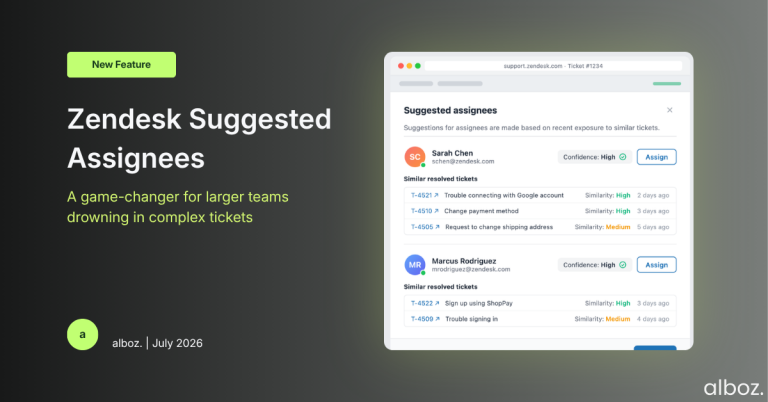
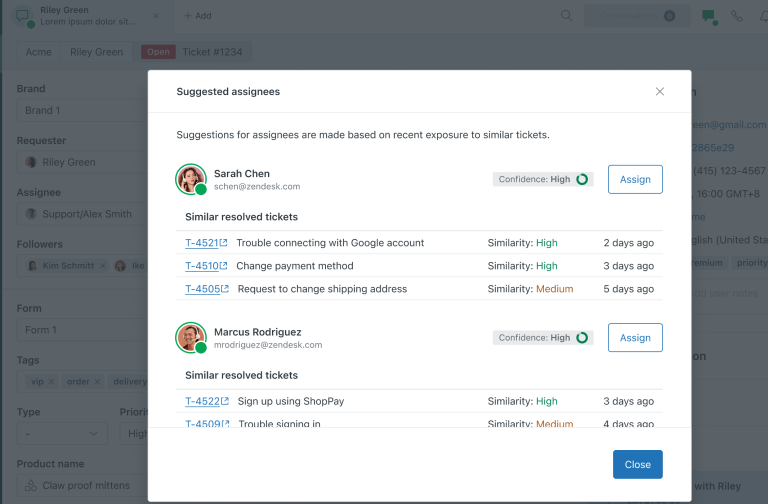
Let’s cut through the marketing jargon. Zendesk is rolling out an AI-powered recommendation engine directly within the ticket interface. When an agent needs to escalate or reassign a ticket, instead of scrolling through a long list of names or guessing who the right expert is, they’ll see a ranked list of suggestions.
This isn’t just a simple list of names. The feature provides some genuinely useful context:
- Supporting Evidence: It shows why an agent is being recommended, citing similar tickets they’ve handled in the past.
- Confidence Score: The AI gives a confidence level for each recommendation, managing expectations about the suggestion’s accuracy.
- Agent Status: Crucially, it displays whether the recommended agent is currently available, busy, or offline.
Agents can then reassign the ticket with a single click from this recommendation list. It’s important to note this is an EAP, meaning it’s still in development, and it’s exclusively available for customers with the Zendesk Copilot add-on.
Our Expert Opinion: The Devil is in the Data
We’re cautiously optimistic about the Zendesk suggested assignees feature. The biggest problem it aims to solve is “ticket handoffs caused by unclear ownership”—what we often call ticket ping-pong. Every time a ticket is passed to the wrong person, the resolution clock ticks up and customer frustration grows. This tool directly targets that pain point.
The two features that stand out to us as having the most significant operational impact are the supporting context and the agent status.
Knowing why an agent is recommended is huge. It builds trust in the system. An agent is far more likely to follow an AI suggestion if it says, “Recommend Jane because she solved three similar refund-request tickets last week.” This turns the feature from a black box into a helpful assistant. Over time, it also helps junior agents learn who the subject matter experts are within the organisation.
The inclusion of agent status is a simple but brilliant piece of practical design. How many times has a high-priority ticket been assigned to an agent, only to sit idle for hours because they were in a meeting or out of the office? By showing real-time availability, this feature prevents tickets from falling into black holes, which is a direct and immediate win for efficiency.
However, there’s a significant caveat. Zendesk’s announcement states that for “optimal” results, an account should have more than 200 resolved tickets. While the feature can work with less, this highlights a critical dependency: the AI is only as smart as the data it’s trained on. If your historical ticket data is messy, inconsistent, or sparse, the recommendations will likely be poor or non-existent. This is not a tool that will fix a flawed process; it’s a tool that will amplify a good one.
How We’d Handle the Rollout: A Phased Approach
Here is what we’re advising our clients to do. Rushing into an EAP without a plan can cause more disruption than it’s worth. We recommend a careful, phased approach to implementing Zendesk suggested assignees.
| Step | Action | Why It Matters |
|---|---|---|
| 1. Confirm Eligibility | Ensure you have the Zendesk Copilot add-on for your plan. Contact your Zendesk Account Manager if you are unsure. | The feature is exclusive to Copilot customers, so this is a mandatory first step. |
| 2. Sign Up for the EAP | Keep an eye out for the in-account prompt to sign up for the open EAP, which Zendesk says will appear by July 2, 2026. | Early access allows you to influence the product’s development and get a head start on adoption. |
| 3. Conduct a Data Sanity Check | Review your last 200+ resolved tickets. Are they assigned correctly? Is the subject matter clear? Is your data clean? | The AI’s performance is directly tied to your data quality. Garbage in, garbage out. |
| 4. Start with a Pilot Group | Enable the feature for a small team of experienced agents or a specific group that handles complex escalations. | This limits the blast radius if there are issues and allows you to gather high-quality, targeted feedback. |
| 5. Establish a Feedback Loop | Create a dedicated channel (e.g., Slack, Teams) for the pilot group to share feedback on the quality of suggestions. | This feedback is invaluable for Zendesk’s EAP and for your own internal decision-making on a wider rollout. |
| 6. Communicate and Train | Before a full rollout, explain to all agents what the feature is, how it works, and that it provides suggestions, not commands. | Managing expectations is key. Agents need to know they still have the final say, which encourages adoption rather than resistance. |
| 7. Measure the Impact | Track key metrics like ‘Reassignments per ticket’ and ‘Full Resolution Time’ before and after implementation to quantify the value. | Data-driven proof of the feature’s impact will justify the investment in the Copilot add-on and further adoption. |
In conclusion, the Suggested Assignees feature represents a genuinely useful application of AI in the daily workflow of a support agent. By providing intelligent, context-aware recommendations, it has the potential to streamline escalations, reduce resolution times, and ultimately lead to a better customer experience. We’ll be watching this EAP closely and advise eligible clients to explore it with a thoughtful, data-first approach.


