Zendesk is constantly evolving its platform, and their August 13th update is a big one for anyone using advanced automation. Get the expert breakdown here.
Free at Last: Zendesk Unleashes Native Automation by Removing Action Credit Costs
What We Think:
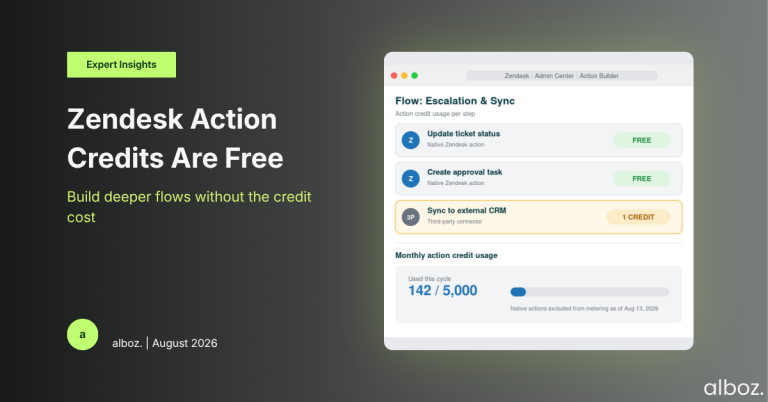
This is a fantastic, user-friendly update. Zendesk is making all native actions (like updating tickets, users, or custom objects) within its action flows completely free. They will no longer consume your monthly allowance of Zendesk action credits. The real impact? This change removes a significant cost barrier, encouraging everyone to build deeper, more complex internal automations without worrying about usage limits. Your credit allowance is now reserved purely for connecting to external, third-party systems. Our verdict: It’s a massive win for customers that simplifies the model and unlocks a new level of automation potential.
The Reality Check: Cutting Through the Jargon
The latest update to Zendesk action credits is refreshingly straightforward. Previously, almost every single step in an action flow, whether it was updating a ticket inside Zendesk or calling an external service, would cost you one action credit. This often made teams hesitant to build multi-step automations for fear of quickly burning through their monthly allowance.
With this change, that limitation is gone for internal processes. Zendesk has split the model in two:
- Now FREE: Any action that happens *within* the Zendesk ecosystem. This includes a huge range of steps that are now effectively unlimited.
- Still Consumes Credits: Actions that connect to the outside world, such as third-party SaaS tools, partner integrations, and custom-built API connections.
To be clear, the list of actions that no longer consume credits is extensive:
- Action flow triggers
- Flow control steps (like conditional branches)
- All native Zendesk actions (for tickets, users, organisations, custom objects, assets, tasks, and approvals)
- Actions invoked by AI Agents and Copilot
- IT asset management actions
- All test runs you perform in the action builder
Your plan’s monthly credit allowance isn’t changing, but since a huge chunk of your automations are now free, those credits will stretch significantly further.
Our Expert Opinion: A Philosophical Shift in Automation
Zendesk states they are making this change so customers can “build seamless, multi-step automations within Zendesk without worrying about usage thresholds on core processes.” We couldn’t agree more. In our view, this is more than just a pricing tweak; it’s a fundamental shift in how Zendesk wants you to use its platform.
By removing the cost from native actions, Zendesk is strongly encouraging the automation of complex internal business logic. Think about intricate, multi-stage approval workflows that touch tickets, users, and custom objects. Or sophisticated SLA breach warnings that perform several checks and updates before notifying an agent. Previously, building these might have been deemed too “expensive” in terms of credit consumption. Now, the gate is wide open.
This move brilliantly redefines the value of Zendesk action credits. They are no longer a metre for general automation but are now positioned as a premium resource for a premium function: system integration. The cost is now directly aligned with the complexity of connecting Zendesk to the rest of your tech stack. This provides much clearer financial visibility into your integration overhead versus your internal process optimisation, which we think is a much smarter model.
How We’d Handle the Rollout: A Strategic Checklist
The announcement rightly states that “no action is required” from a technical perspective—the change will happen automatically. However, from a strategic perspective, this is a golden opportunity that requires action. Here is what we’re advising our clients to do.
| Phase | Action Item | Our Recommendation |
|---|---|---|
| Phase 1: Audit & Review | Analyse your existing action flows and credit usage. | Log in to the Admin Centre and identify which of your current flows were the most “credit-heavy.” Pinpoint the ones that relied on many native Zendesk steps. These are your prime candidates for immediate expansion and enhancement. |
| Phase 2: Ideate & Strategise | Brainstorm new automation possibilities that were previously unfeasible. | Get your team together and ask: “What processes did we avoid automating because of credit costs?” This could be anything from a detailed agent onboarding checklist to a multi-step customer feedback loop. It’s the perfect time to rethink what’s possible, and our Zendesk consulting services can help facilitate these strategic sessions to unlock new potential. |
| Phase 3: Monitor & Optimise | Establish a new baseline for your credit consumption. | Keep a close eye on the Usage Summary page. Your usage patterns will now give you a much cleaner signal, reflecting only your external and custom integration costs. This data is invaluable for managing your integration budget and making informed decisions about which third-party tools are providing the most value. |
A Clear Path Forward for Automation
Ultimately, this update is a significant quality-of-life improvement for every Zendesk admin and CX leader. It simplifies the cost model, removes friction, and actively encourages you to leverage the full power of the platform’s native automation capabilities. We see this as a clear signal that Zendesk is committed to making sophisticated process automation a core, accessible part of its offering, not a metered add-on. It’s a welcome change and one that we believe will lead to more innovative and efficient support operations.