
Zendesk continues its relentless pace of innovation, dropping new features and enhancements that keep us on our toes. Here’s our expert breakdown of the latest announcement from early September.
What We Think:
The new Zendesk Universal Connector is a genuinely transformative tool for any organisation with a custom-built or niche knowledge base. It breaks down the walls between Zendesk and your proprietary systems by allowing you to connect any REST/JSON API-based content source directly into the Zendesk Knowledge Graph. This is a massive win for centralising information and empowering agents with the data they actually need, right where they need it. It moves beyond pre-built integrations, giving admins the power to connect to practically anything without needing extensive developer resources.
The Reality Check: What’s Really Changing?
Let’s cut through the jargon. For years, getting external knowledge into Zendesk meant either hoping a pre-built app existed for your specific tool (like Confluence or SharePoint) or embarking on a costly, custom development project. This left a huge gap for companies using homegrown wikis, internal product databases, or other niche systems.
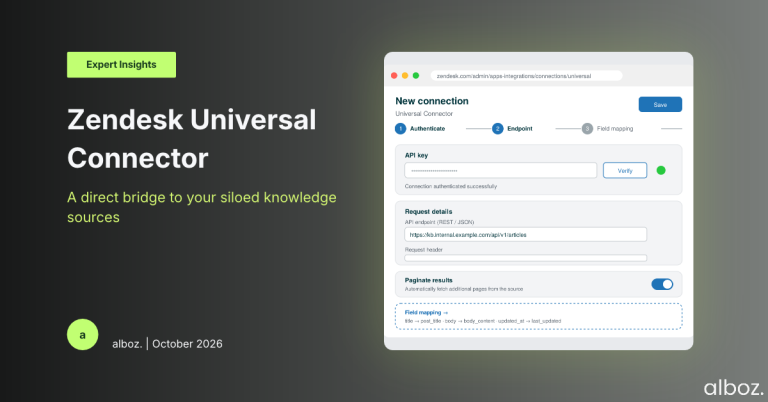
Zendesk’s new Universal Connector changes that. In essence, Zendesk is handing admins a set of keys. If your external knowledge system can expose its content via a REST/JSON API (which is a very common standard), you can now wire it directly into Zendesk yourself. You don’t need a dedicated integration app anymore. You simply provide an API key and then configure how Zendesk should “read” the data from your source by mapping the fields, setting up the connection details, and handling things like pagination.
The result? That once-siloed information from your internal systems can now surface across Zendesk’s knowledge experiences, just like native Help Centre articles. It’s a powerful step towards a truly unified knowledge ecosystem.
Our Expert Opinion: Why This Matters Operationally
Our team sees this as more than just a new connector; it’s a fundamental shift in how organisations can approach knowledge management. The real impact here is on agent efficiency and answer consistency.
Think about the typical agent workflow. A customer asks a complex question about a niche product feature. The answer isn’t in the public-facing help centre; it’s buried in an internal engineering wiki. Before, the agent had to swivel-chair over to that other system, search for the answer, and then copy-paste it back into the ticket. This process is slow, error-prone, and frustrating for both the agent and the customer.
The Zendesk Universal Connector solves this by pulling that internal content into the same environment the agent is already working in. The biggest advantage is the level of control it provides. Admins can precisely configure:
- The API Endpoint: You tell Zendesk exactly where to look for the information.
- Request Details: You can customise headers and other parameters to authenticate and fetch the data correctly.
- Response-Field Mappings: This is the crucial part. You can map the fields from your source (e.g., `post_title`, `body_content`, `last_updated`) to corresponding fields in Zendesk. This ensures the content is structured and displayed properly.
- Pagination: It can handle sources with thousands of articles by correctly fetching content page by page.
This level of configurability democratises integration. Furthermore, by feeding these rich, internal data sources into the Knowledge Graph, you’re also supercharging your AI capabilities. The information pulled in via the Zendesk Universal Connector can be used to power more accurate bots and provide more relevant agent-facing suggestions, a key component of the overall Zendesk AI strategy.
How We’d Handle the Rollout: A Phased Approach
Here is what we’re advising our clients to do. Don’t just turn it on. A strategic rollout is key to getting the most out of this powerful feature. We recommend a structured, five-phase approach.
| Phase | Key Actions | Our Advice |
|---|---|---|
| 1. Discovery & Prioritisation | Identify all potential internal knowledge sources. Interview team leads to find out where agents are manually searching for information today. Prioritise the source with the highest impact on resolution time. | Start with one high-value source. Don’t try to connect everything at once. Prove the value, then expand. |
| 2. Technical Configuration | Work with the team that owns the source system to get API documentation and an API key. In Zendesk, configure the endpoint and map the response fields. | We recommend setting this up in your Zendesk Sandbox first to avoid any impact on your live environment. |
| 3. Pilot Testing | Roll out the new connected source to a small, select group of experienced agents. Gather direct feedback on the quality and accessibility of the content. | Create a specific feedback channel for the pilot group. Ask them: “Is this saving you time?” and “Is the formatting correct?” |
| 4. Agent Training & Launch | Based on pilot feedback, refine the configuration. Hold a brief training session for all agents to demonstrate how to find and use the new content. Announce the full launch. | Focus the training on the “why.” Explain how this new source helps them solve customer issues faster. |
| 5. Monitor & Iterate | Keep an eye on API usage and performance. Continue to gather feedback from the wider team and look for opportunities to connect other valuable knowledge sources. | This isn’t a “set it and forget it” feature. Your knowledge sources will evolve, and your connection may need tweaking over time. |
Unlocking Your Organisation’s True Knowledge
Ultimately, the Zendesk Universal Connector is a powerful tool for breaking down information silos that hinder great customer service. By enabling a direct line to your unique, internal knowledge, Zendesk is empowering agents to be more effective and self-sufficient. If your organisation relies on custom-built systems, this announcement should be on your immediate radar. If you need help planning your integration strategy, don’t hesitate to contact your alboz. Solution Consultant to map out the best path forward.


