Zendesk’s feature pipeline is always humming, and this October, they’ve dropped a significant announcement about the future of AI. We’re here to break down what it means for you.
Zendesk is Swapping Visual Maps for Plain English: Our Expert Take on the New Zendesk AI procedures
What We Think:
Zendesk is fundamentally changing how AI agents are built by moving from visual, flowchart-style maps to natural language text instructions. This is a massive, and in our opinion, positive step forward. While it might feel like a big shift for teams used to visual builders, this move promises to make bots more intelligent, easier to manage for non-technical users, and more consistent across the entire Zendesk AI suite. It’s a trade-off of rigid visual control for more powerful, nuanced AI reasoning. We believe the long-term benefits in bot accuracy and resolution rates will far outweigh the short-term learning curve.
The Reality Check: What’s Actually Changing?
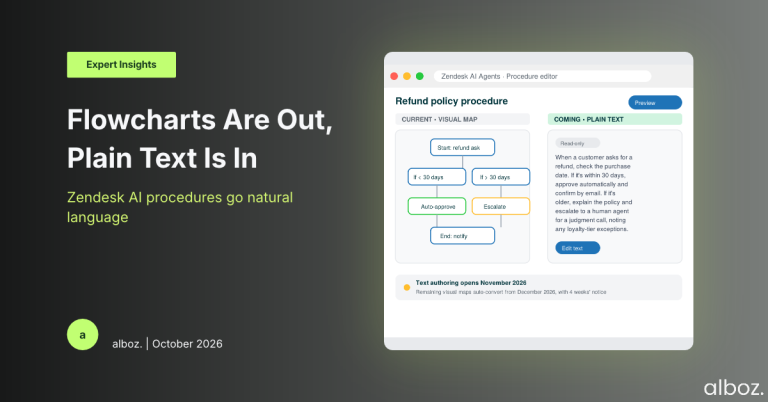
Let’s cut through the jargon. For years, building a bot in Zendesk meant creating a visual “procedure map” — a flowchart of boxes and arrows dictating the conversation’s logic. If a customer says X, the bot does Y. If they say Z, it follows another path. This is a very structured, predictable way of building automated conversations.
Zendesk is now phasing this out in favour of something much simpler on the surface: plain text. Instead of a map, you’ll write out instructions for your AI agent in simple sentences, much like you’d write a standard operating procedure for a new human agent. The goal is to move from a rigid, “if-this-then-that” system to one where the AI can understand the *intent* and *nuance* behind your policies.
Think of it as the difference between giving someone a fixed set of driving directions versus telling them “Get to the city centre, but avoid the motorway if it’s rush hour and take the scenic route if you have time.” The latter allows for more intelligent, context-aware decisions, and that’s the power Zendesk is aiming to unlock with these new Zendesk AI procedures.
Our Expert Opinion: Why This Is a Game-Changer
The key phrase in Zendesk’s announcement is that natural language gives the AI “richer intent to reason from.” This is the core of the entire update. A visual map is inherently limited. It can’t easily handle ambiguity, exceptions, or complex judgment calls without becoming a sprawling, unmanageable mess of branches and conditions.
By using plain text, you’re not just defining a path; you’re explaining the *why* behind the policy. This allows the AI to apply your rules more accurately and, crucially, handle situations you didn’t explicitly map out. This is a significant leap in capability, pushing Zendesk bots further away from simple FAQ-responders and closer to genuine AI agents that can resolve complex issues. As we’ve discussed in our guide to Zendesk Bots, the evolution of this technology is rapid, and this is a clear example of that progress.
Another major benefit is operational consistency. Zendesk has been weaving AI into various parts of its platform, like auto assist for human agents. By standardising on natural language procedures, the way you manage and guide AI becomes the same everywhere. An admin who can write a procedure for an AI agent can now apply that same skill to other AI features. This lowers the training barrier and creates a more unified, manageable system.
Of course, this isn’t without its challenges. Teams will need to learn how to write effective prompts and procedures. Vague or poorly written instructions could lead to unpredictable AI behaviour. However, Zendesk is mitigating this with a very long, phased rollout, giving everyone plenty of time to adapt.
How We’d Handle the Rollout: A Strategic Checklist
Zendesk has laid out a gradual transition plan stretching into late 2027. You don’t need to do anything immediately, but inaction is not a strategy. Here is what we’re advising our clients to do to prepare for the shift in Zendesk AI procedures and ensure a smooth transition.
| Phase | Timeline | Our Recommended Actions |
|---|---|---|
| Phase 1: Preview & Review | Now (from Oct 2026) |
|
| Phase 2: Opt-In & Experiment | From Nov 2027 |
|
| Phase 3: Full Migration | From Dec 2027 |
|
In summary, this shift to natural language procedures is a strategic and necessary evolution for Zendesk’s AI offerings. It aligns with the broader industry trend towards more conversational and intelligent automation. By embracing this change proactively and following a structured rollout plan, you can unlock a new level of performance and efficiency from your AI agents.