
Love them or hate them, Amazon has amazing customer service. Recently, they incorrectly charged me for delivery. Without fuss, they refunded the charge, apologised profusely and then as I was about to smugly end the chat satisfied with the quick, efficient and friendly interaction the agent drops a closing note that went something like this: “To say we’re sorry, we’re loading up your account with a €10 gift card.”
I was like “WOW” 🤩.
An hour later I had spent a whole lot more than €10 with that voucher.
That reminded of the huge revenue opportunities out there just laying dorment in the customer support department.
This month I’m tackling that old debate once again now that we’re well and truly in the AI era let’s tackle the question – is customer support still considered a cost centre? If so, why?
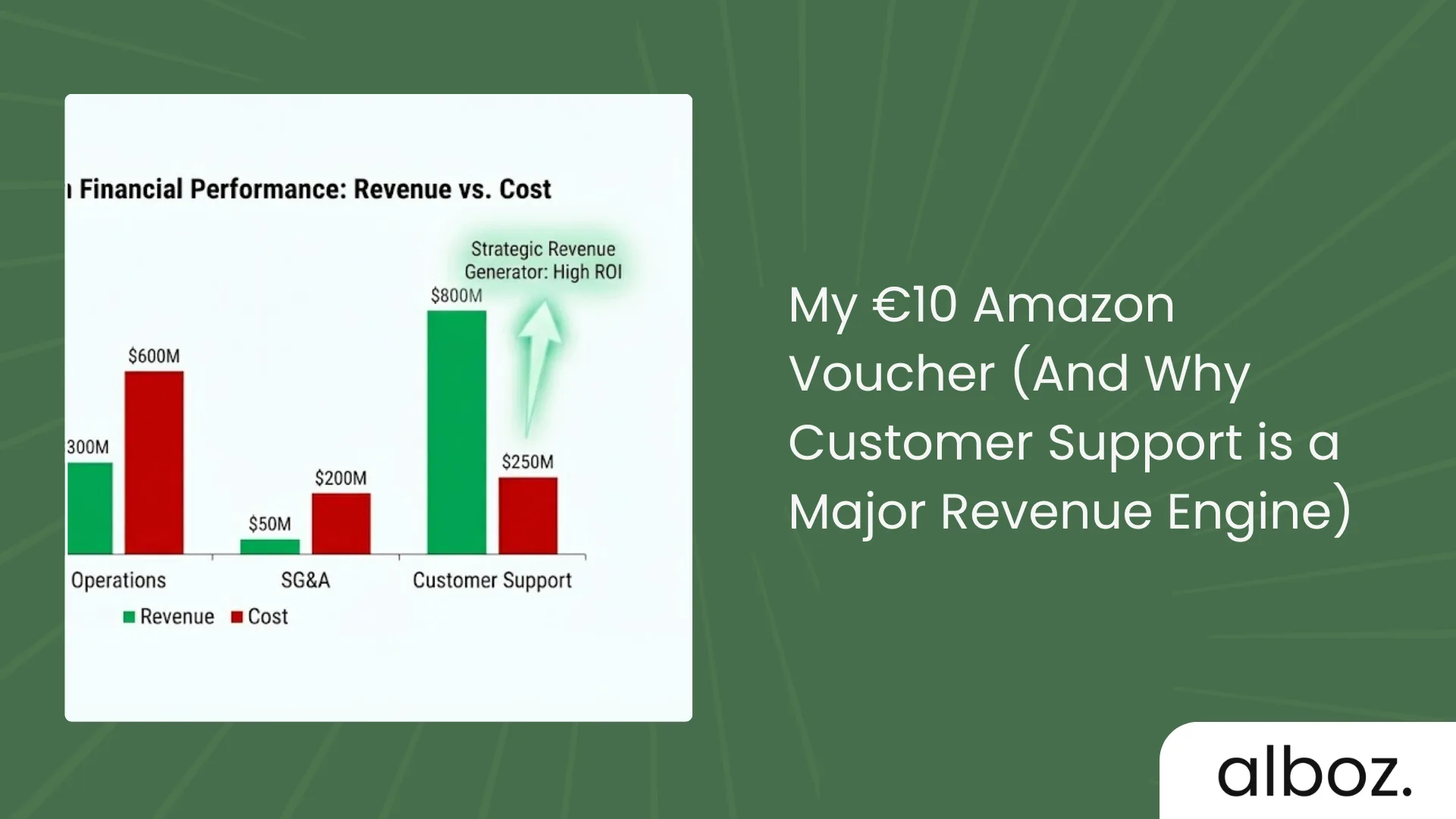
The financial narrative surrounding Customer Support has been simplistic and damaging. It is viewed as a cost centre, a drain on the P&L that sits alongside rent and electricity. The strategy has been defensive. Deflect tickets, reduce handling time, and cap costs.
This is a strategic error.
In a modern digital economy, Customer Support is not a cost to be minimised. It is an investment to be optimised.
By shifting the lens, we can see that Support is actually a revenue engine waiting to be switched on. Here is how you move from defence to offence.
Here are 5 ways you ensure your Customer Support is a major revenue engine,
1. Making Money While You Sleep with AI Agents
The current buzz around AI often focuses on deflection, or stopping customers from speaking to humans to save pennies.
This is small-minded.
The real value of AI Agents (AI on the customer facing side) lies in their ability to generate revenue where humans cannot. Let’s explore a few ways.
Your human sales team sleeps, but your AI Agent does not.
A sophisticated AI Agent is not just a glorified FAQ bot. It is a transactional tool. When a customer asks about product compatibility at 2:00 AM, the AI Agent can confirm the details, recommend the correct accessory, and guide them to checkout immediately. It captures revenue that would otherwise leak away due to friction or delay.
Then there is the strategic apology.
Service failures happen. However, a cost centre mentality offers a generic apology and the customer leaves unhappy. A revenue mindset uses intelligent automation to turn that failure into a future transaction similar to my Amazon experience. Let’s take another example.
Imagine a workflow triggered by a negative support interaction, like a delivery delay detected by the system. Instead of just saying sorry, an automation triggers immediately after the ticket closes to issue a unique, time-limited voucher. It says we let you down on delivery, so here is €5 off your next order to help us make it up to you. This achieves two things.
- First, it validates the customer’s frustration with a tangible gesture.
- Second, it locks in the next purchase.
You aren’t just apologising; you are securing the next sale. The cost of the voucher is effectively a marketing acquisition cost, but with a much higher conversion rate than a Facebook ad.
2. Service-Led Sales and the Un-Sales Pitch
Your Support agents are uniquely positioned to sell because they possess the one thing your Sales team often lacks. Immediate trust. They are not calling to hit a quota. They are answering a cry for help.
When a customer is struggling, they are most open to a solution, even if that solution has a price tag.
This isn’t aggressive selling. It is consultative solving.
Take the upsell.
If a customer contacts support complaining about hitting data limits or missing functionality, the solution is often an upgrade. You need to train agents to stop apologising for the limitation and start offering the expansion. If the Professional Plan automates the workflow and removes the limit they are complaining about, offering that upgrade is an act of service.
Then there is the cross-sell safety net.
Agents often see the full picture of a customer’s usage. They can identify gaps that the customer might not even realise exist. If a customer buys a laptop but struggles with installation, the agent helps with the setup and then notes that a maintenance kit or extended warranty would save them this hassle in the long run.
By framing the purchase as a safety net or a time-saver, the agent generates revenue simply by being helpful.
3. The Copilot Revenue Multiplier
We cannot expect support agents to memorize every product SKU, pricing tier, or discount code. This is where investing in Agent Copilot technology truly pays dividends.
Modern Copilot tools do much more than just summarize tickets or polish grammar.
They can act as a real-time revenue radar. By combining customer intent detection with data from your backend systems, Copilot can surface sales opportunities the moment they arise.
For example, if a customer asks about adding users.
Instead of passing them off to your sales team and the frsutration that goes with it, Copilot can instantly detect the intent to ‘Scale’ and prompt the agent with the relevant Enterprise pricing. We can even analyze customer history or pull specific data points from the CRM to flag eligibility for loyalty discounts or annual plan upgrades.
This removes the heavy lifting. Agents don’t need to be salespeople, they simply need to follow the intelligent prompts provided by their workspace.
4. Indirect Revenue and the Feedback Loop
Your Product and Engineering teams operate in a bubble, but your Support team operates in reality.
When Support is siloed as a cost centre, valuable data dies in the ticketing system.
When viewed as a strategic asset, Support becomes your cheapest form of Market Research.
If 500 customers ask for a specific integration, that is not just complaint volume.
That is a roadmap for a paid add-on. Support also flags exactly why customers leave, be it price, missing features, or poor UI. This provides the roadmap to fix the leak. Plugging the hole is just as valuable as pouring more water in.
5. The Baseline: Retention Economics
Finally, we have to acknowledge the foundational truth that acquiring a new customer costs significantly more than retaining an existing one.
While this is nothing new, it is the bedrock of the revenue argument.
Every ticket resolved with empathy and speed is a customer saved. If your Support team reduces churn by just 1%, the compound revenue effect over 12 months often dwarfs the entire operational cost of the department.
Bottom Line
A cost centre fixes problems as cheaply as possible. A revenue generator solves problems to build loyalty and deepen the commercial relationship.
The companies that win in the next decade will be the ones that realise their best salespeople are arguably the ones wearing headsets, utilising AI Agents and Copilot to compliment their human agents to solve problems, and issuing apology vouchers that drive the next wave of sales.
So, is customer support still considered a cost centre? Leave a comment.
If you think customer support is a still a cost …. let’s chat and find new revenue opportunities together.
📆 Book a call ↗
Not a Zendesk customer yet? Get a free 14-day trial today here ↗
Just browsing? Checkout the alboz. website for more insights.